Wednesday, December 24, 2014

Ho Ho Ho! Track Santa around the world with Santa Tracker

After 23 days of preparation, the elves are finally ready for Santa’s annual journey around the globe. They’ve taught each other how to say "Santa Claus" in Swedish, guided their friends through mazes with code, brushed up on their geography, and learned about organizations making a difference worldwide. It’s been a busy month, but Santa’s sleigh is now ready for lift-off!
The elves brushed up on coding fundamentals with blockly maze games

The elves decorated their trees with ornaments about organizations making a difference

Each stop on Santa’s journey offers more to explore—discover 360-degree imagery, Wikipedia snippets, geography facts, and updates on how far Santa’s current location is from yours (take note—Santa’s path is not a direct one!). Come back and visit google.com/santatracker throughout the night for more surprises, like sleigh selfies or a latitude and longitude game to deliver presents.
Follow Santa on any screen—desktop, phone, tablet, or TV

If you’re on the ho-ho-go, download the Santa Tracker App for Android to keep track of Santa on your phone or tablet. With the Android app, watch Santa’s journey on your TV using Chromecast, or on your wrist with Android Wear (especially handy when wrapping last-minute gifts). And, you can always search for Santa on www.google.com or on Google Maps, and get real-time location updates with Google Now in the Google App.

Santa’s available at the flick of the wrist with Android Wear

Santa’s got a long and exciting night ahead of him before heading back to the North Pole. Grab some eggnog, set out the cookies, and join Google Maps on Google+, Facebook and Twitter to #tracksanta!

Monday, December 22, 2014

New numbers and a new look for our Transparency Report

We launched the Transparency Report in 2010 to show how laws and policies affect access to information online, including law enforcement orders for user data and government requests to remove information. Since then, many other companies have launched their own transparency reports, and we’ve been excited to see our industry come together around transparency.

After doing things the same way for nearly five years, we thought it was time to give the Transparency Report an update. So today, as we release data about requests from governments to remove content from our services for the ninth time, we’re doing it with a new look and some new features that we hope will make the information more meaningful, and continue to push the envelope on the story we can tell with this kind of information.

More about that shortly—first, the data highlights. From June to December 2013, we received 3,105 government requests to remove 14,637 pieces of content. You may notice that this total decreased slightly from the first half of 2013; this is due to a spike in requests from Turkey during that period, which has since returned to lower levels. Meanwhile, the number of requests from Russia increased by 25 percent compared to the last reporting period. Requests from Thailand and Italy are on the rise as well. In the second half of 2013, the top three products for which governments requested removals were Blogger (1,066 requests), Search (841 requests) and YouTube (765 requests). In the second half of 2013, 38 percent of government removal requests cited defamation as a reason for removal, 16 percent cited obscenity or nudity, and 11 percent cited privacy or security.

As for the redesign, we’ve worked with our friends at Blue State Digital on a more interactive Transparency Report that lets us include additional information—like explanations of our process—and highlight stats. We’ve also added examples of nearly 30 actual requests we’ve received from governments around the world. For example, we have an annotation that gives a bit of descriptive information about our first government request from Kosovo, when law enforcement requested the removal of two YouTube videos showing minors fighting. If you’re looking for details on the content types and reasons for removal, use the Country explorer to dig into those details for each of the listed countries.*

Our Transparency Report is certainly not a comprehensive view of censorship online. However, it does provide a lens on the things that governments and courts ask us to remove, underscoring the importance of transparency around the processes governing such requests. We hope that you’ll take the time to explore the new report to learn more about government removals across Google.

*Update Jan 16: We updated the 'Country Explorer' section of the Transparency Report on January 16, 2015 to correct inaccuracies in the initially reported Government Requests figures.

Friday, December 12, 2014

Life in the fast lane: lane guidance for drivers in Google Maps

Over the holiday season, if you’re driving back home to see family, or meeting up with friends, you can get where you want to go quickly and easily using voice-guided navigation in Google Maps — now with helpful lane guidance for highways in Germany, France, Italy, Spain, the UK and Ireland.


When you’re in the turn-by-turn navigation mode, we can now make sure you don’t miss your next turn or exit by showing you which lane to stay in or move to so you’ll never find yourself darting across traffic at the last minute -- or worse, driving for miles down the wrong road. When you approach a junction or exit with multiple lanes, voice guidance will suggest which lanes are best for your route. You’ll also have easy access to alternate routes while you’re navigating, so you can choose the best drive for you.

To access turn-by-turn Navigation, open the Google Maps app on Android or iPhone and get directions to a location. Then simply touch the Navigation icon to hear voice-guided directions, complete with lane guidance. (Of course, don’t forget to enable GPS on your device to use Navigation.) For more information on navigation and lane guidance, see our help page.

Safe travels!

Thursday, December 11, 2014

An update on Google News in Spain

After 9/11, one of our engineers, Krishna Bharat, realized that results for the query “World Trade Center” returned nothing about the terrorist attacks. And it was also hard to compare the news from different sources or countries because every web site was a silo. That’s how Google News was born and today the service is available in more than 70 international editions, covering 35 languages.

It’s a service that hundreds of millions of users love and trust, including many here in Spain. It’s free to use and includes everything from the world’s biggest newspapers to small, local publications and bloggers. Publishers can choose whether or not they want their articles to appear in Google News -- and the vast majority choose to be included for very good reason. Google News creates real value for these publications by driving people to their websites, which in turn helps generate advertising revenues.

But sadly, as a result of a new Spanish law, we’ll shortly have to close Google News in Spain. Let me explain why. This new legislation requires every Spanish publication to charge services like Google News for showing even the smallest snippet from their publications, whether they want to or not. As Google News itself makes no money (we do not show any advertising on the site) this new approach is simply not sustainable. So it’s with real sadness that on 16 December (before the new law comes into effect in January) we’ll remove Spanish publishers from Google News, and close Google News in Spain.

For centuries publishers were limited in how widely they could distribute the printed page. The Internet changed all that -- creating tremendous opportunities but also real challenges for publishers as competition both for readers’ attention and for advertising Euros increased. We’re committed to helping the news industry meet that challenge and look forward to continuing to work with our thousands of partners globally, as well as in Spain, to help them increase their online readership and revenues.

Wednesday, December 10, 2014

Bringing the museum to your mobile

Enter the Museum of Arts et Métiers in Paris and one of the first things on view is a strange looking plane perched over a historic staircase. Wonder what it is? From today, click on a mobile app based on Google Cultural Institute platform and learn about Clement Adler’s 120-year old rival to the Wright Brothers.

The platform allows museums to create a simple but powerful mobile app, based on Google's technology including Street View and YouTube. Without resorting to expensive technical help, museums now can tell their stories. Interested institutions should sign up here.

Eleven museums and cultural institutions in Italy, France, the Netherlands and Nigeria, have worked with our engineers on this pilot project. Their apps are available for free on the Google Play store.


In Turin, discover the riches of the near and far East at MAO, wonder at the surprising artworks at GAM, and go instantly from the Middle Ages to contemporary photography at Palazzo Madama. Or discover the international street artworks and their authors,brought together by the Emergence Festival. Finally, stroll through MAGA to find out more about the Italian contemporary art scene.

In France, enter Marie Curie’s office and relive the discovery of radioactivity at the Musee Curie. Drive hrough the impressionist collection of the Museum of Le Havre (MuMa) with six audio thematic tours, and the Monnaie de Paris offers a guid through contemporary artist Paul McCarthy's Chocolate Factory.

In the Netherlands, visit the Rijksmuseum van Oudheden. Its app explores archaeological treasures from Egypt, Rome, and the Netherlands. Curious about the history of Nigeria?  Discover the story of the Amalgamation of the Southern and Northern Protectorate 100 years ago thanks to the Pan-Atlantic University app.


Particularly enjoy an artwork or love the story behind an object? These mobile apps allow easy sharing with friends. Because Internet access can be a challenge when traveling abroad, we made sure these apps will work when you're offline.

The Internet no longer plays just a minor role in diffusing museum knowledge. It has become a major force, allowing museums to expand and strengthen their reach. We look forward to deepening our partnership with museums that see digital media as core to their mission of education and inspiring people about art and culture.

Competition drives Europe's mobile market

IBM launched the first smartphone only 20 years ago. Nicknamed Simon, it weighed more than a half a kilo, cost more than EUR1400 in today’s money, and lacked a touch screen or web browser.

Today, at a Lisbon Council event in Brussels, The Boston Consulting Group released a new study we commissioned showing that, fueled by stiff competition, the mobile Internet economy in the Europe’s five largest economies generates annual revenue of EUR92 billion -- encompassing sales of devices, access, advertising, and everything you do on the mobile web. This slice of the economy has also created 250,000 jobs in Germany, the UK, France, Italy, and Spain.


By 2017, mobile revenue in these five countries will have more than doubled to about EUR230 billion - an annual growth rate of more than 25 percent. This boom doesn’t come from rising prices. To the contrary, it’s propelled by increasing affordability and accessibility. The average selling prices for smartphones in Europe are projected to fall almost 38 percent by 2017.


Importantly, BCG found competition occurring “at every layer of the mobile ecosystem - among service providers, enablement platforms and companies providing apps, content and services.” Competition is particularly intense among phone manufacturers and operating systems. As recently as 2010, the BlackBerry and Symbian platforms accounted for almost half of smartphone sales; today they represent less than five percent. Apple’s iOS, Google’s Android, and Microsoft’s Windows are locked in fierce competition, while new entrants include Amazon’s Fire, Xiamo MIUI, Firefox OS, and Tizen.


A big part of this success story is the flourishing app economy. More than 100 billion downloads took place in 2013 around the globe - about 20 billion in the European Union. Leading app store operators paid developers more than EUR12.2 billion between June 2013 and July 2014. Many of the world’s most dynamic app developers and mobile game operators are based here in Europe, including Finland’s Rovio, the developer of Angry Birds, UK-based Shazam, Wooga in Germany, and Sweden’s Spotify.

All told, the mobile economy is driving economic growth and jobs. The mobile web informs, entertains, and helps us navigate the world. I have no doubt that further innovation and new growth opportunities will mark mobile’s next 20 years!

Blasting off from a LaunchPad in Barcelona

Barcelona is already known for its sunshine and seashore. Now, according to the Financial Times, it aims to become just as well known for its start-ups. Last week, Google LaunchPad took place in the Catalan capital. The one-week program is designed to accelerate the growth of local, early stage tech companies, and part of our Startup Launch program. It’s our fourth LaunchPad in Europe, following events in Tel Aviv, London, Sao Paulo, Berlin and Paris.

A strong case exists for Barcelona to become a start-up hub, the Financial Times says. “Barcelona is known as the ‘north of the south’ – combining a cosmopolitan business-friendly city with Mediterranean coast sunshine. Two international business schools, Iese and Esade, attract talent from across the world. The city hosts one of the world’s top supercomputing centres.”

At our LaunchPad, local incubators itnig, Incubio, Connector, Tetuan Valley and Caixa Capital Risc picked 14 startups to attend. During the week, some 30 mentors work individually with them on their projects, as they are experts in their fields and in most cases experienced entrepreneurs. Workshops cover product strategy, UX/UI, technology and marketing.

This initiative underlines our commitment, once again, to Spanish entrepreneurship. Despite suffering a drastic downturn in the financial crisis, the country is emerging as strong start-up nation. According to the Map of Entrepreneurship in Spain 2014, 95% of entrepreneurs decide to become so out of motivation rather than necessity AND 16% of the new projects are launched Catalonia. Barcelona always will be a beautiful city. It is in the process of becoming a modern Internet hub.

Tuesday, December 9, 2014

Apply for a computer science award

High schools need to increase their computer science offerings and we’re eager to support. Starting today, applications are now being accepted for the 2015 Google Computer Science for High School Awards. Universities who meet our eligibility criteria can apply for an award of up to $15,000. Apply before midnight (GMT), February 20th, 2015.

High school computer science courses face challenges throughout Europe, the Middle East and Africa. Many teachers can have limited access to training and curriculum resources, struggle to keep up with fast changing technology or have difficulty demonstrating that computer science can be a rewarding and “cool” career choice.

Google’s Computer Science for High School Awards connects school teachers with university academics, who can provide them with the training and tools. Since its pilot in 2009, the program has sustained computer science teacher professional development and helped inspire a new generation of computer scientists who will build the apps and programs of the future.

To date, our program has trained more than 12,263 teachers, reaching an estimated 613,150 students in more than 230 locations worldwide. In 2014, we supported 26 university-led education projects in 20 countries - with projects ranging from SCRATCH and Raspberry Pi teacher workshops in Europe to android and robotics programming workshops for female students in the Middle-East.

We have resources for teachers to get ongoing, year-round help. Our Google+ Community page hosts Hangouts on Air with Computer Science industry leaders, Googlers, and top educators on a regular basis and we have a resources page with online workshops, tutorials and information on computational thinking, robotics and more.

This year we've added a new computer science custom search for additional materials (such as lesson plans, tutorials, activities, and videos) to support classroom activity, after school programs, or for home enrichment. Our ultimate goal is ambitious — to “train the trainer,” develop a thriving community of high school Computer Science teachers, and above all, engage pre-university students about the awe and beauty of computing.

Monday, December 8, 2014

Bringing a fresh digital vision from “New Europe” to Brussels

While Old Europe ponders its approach to the digital future, New Europe is rushing ahead to embrace the web as a motor for growth and prosperity. This past autumn, together with Financial Times, International Visegrad Fund and Res Publica, we announced the New Europe 100 list of innovators from Central and Eastern Europe.This past week, many of these entrepreneurs came to Brussels to present their ideas to the European Parliament


The event featured real-life success stories :
The European Parliament New Europe 100 event
  • Kamila Sidor, CEO, Geek Girl Carrots from Poland who runs a successful social innovation movement to encourage more women into ICT careers.
  • Michaela Jacova, Investment Manager, Neulogy VC from Slovakia, who supports aspiring talented entrepreneurs by awarding grants and matching with VC investors.
  • Paul-Andre Baran, Director, Biblionet from Romania, who helps provides free access to computers and the internet through public libraries.
  • Marcin Beme, CEO, Audioteka.pl from Poland, who founded a successful mobile platform offering digital audiobooks in Poland, Czech Republic, Hunagry , Spain, FInland, Sweden, Russia, Germany, France and Romania.
  • Gergana Passy, Digital Champion of Bulgaria, who advocates for a free access to the internet, e-skills and digital transformation across the society.
MEP Boni and Google's Vint Cerf
MEP Michal Boni, former minister for digitization in Poland, hosted the debate, which featured a keynote address from Vint Cerf, Google’s Chief Internet Evangelist. Policymakers from around New Europe attended, including MEP Janusz Lewandowski, former Polish EU Commissioner; MEP Antanas Guoga from Lithuania, and Prof. Ziga Turk of University of Ljubljana and Former Minister for Growth in Slovenia.

All listened to the entrepreneurs offering important lessons on technology­-driven innovation. Apart from sharing personal passion for ICT-driven innovation, the New Europe called on the politicians to create a positive environment for innovation. Their proposed ingredients include accepting business failures, attracting more women in ICT careers, increasing access to the Internet across the society, and simplifying rules for trading across the borders. Together, these measures represent a positive recipe for creating a true European digital single market.

Thursday, December 4, 2014

Coding for democracy in Europe

It was an audacious task - write software that would increase democratic participation in Europe. At a time when polls show increasing public disenchantment with traditional European Union institutions, the latest and 4th edition of the EUhackathon focused on getting European citizens more involved in the EU policymaking progress.


A total of 41 coders from all over Europe participated this week in Brussels. In addition to Google, Facebook, ICANN and Netflix sponsored the event.

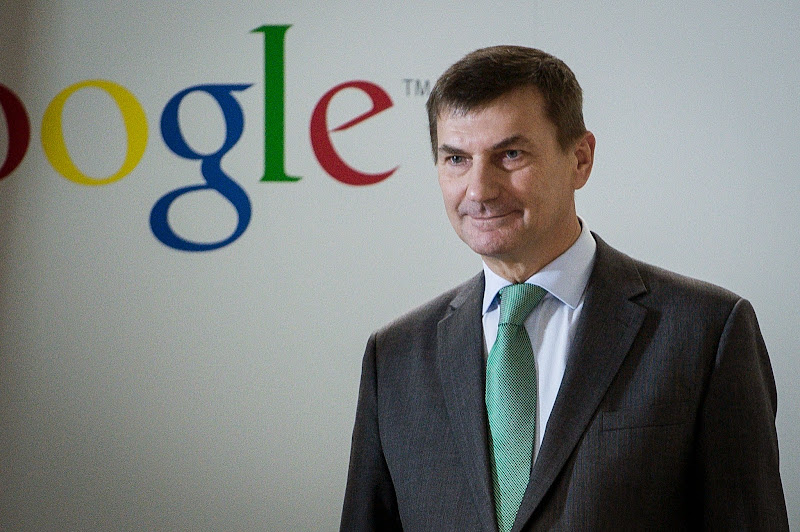
Andrus Ansip, European Commission Vice-President for the Digital Single Market, and Alexander De Croo, Belgian Vice-Prime Minister and Minister for the Digital Agenda, visited the coders at the Google Brussels office. Google Vice President and Internet evangelist (and “father” of the Internet) Vint Cerf, offered additional encouragement.

Belgian Minister Alexander De Croo and European Commissioner Andrus Ansip
Vint Cerf with Commissioner Ansip
After 30 hours of intense coding with only a single four-hour break, the jury heard presentations of the projects. The prize giving ceremony took place at the European Parliament – MEPs Julia Reda, Andrey Novakov, Brando Benifei, Eva Paunova and Marietje Schaake announced the winners:
  • First Prize: Team Videodock (the Netherlands), created a cool search for finding videos of parliamentary debates.
  • Second Prize: Team Commission Today (Romania/Germany/USA), created a transparency register of the meetings of the EU Commission.
  • Third Prize: Team Frontwise (the Netherlands),developed a tool to make easier to access to EU public consultations.
The winning Dutch team receives their prize

Wednesday, December 3, 2014

Bringing a key moment of Gulf history online

Our Paris-based Cultural Institute holds a global mandate to promoting culture around the globe. This week, it is reaching out to the Arab world, bringing online the United Arab Emirates national archives - our first Arab archives, and only third globally, after those of the United States and the Netherlands.

The exhibit highlights historic moments leading up to the formation of the Emirates in 1971. In three short decades, the Emirates have transformed themselves into global hubs for transport and commerce. Among the items on display range from the first flag-hoisting after the Emirates's establishment - to duplicates of the first national set of stamps.

We are keen to showcase more of the history of the Middle East, home to some of the most ancient cultures and civilizations. The Cultural Institute works with partners to make cultural content accessible online and preserve it for the future, whether it’s galleries like the British Museum to heritage sites like Versailles, or historical moments like Nelson Mandela’s handwritten prison letters and the fall of the Berlin Wall.